How to Read Betting Odds: Implied Probability & Value Explained
How to Read Betting Odds: Implied Probability, Vigs, and Finding Real Value
Most bettors don't understand what betting odds actually mean. This guide explains implied probability and why the vig is quietly eating your bankroll.
Fractional vs Decimal vs American Odds Explained Simply
Betting odds come in three formats. They all represent the same thing — the return you get if your bet wins — but look different depending on where you are betting.
Fractional Odds (UK/Ireland)
Written as fractions like 5/1, 9/2, or Evens (1/1). The first number is your profit; the second is your stake.
Example: 5/1 means for every £1 you bet, you win £5 profit plus your £1 stake back = £6 total return.
Example: 9/2 means for every £2 you bet, you win £9 profit plus your £2 stake back = £11 total return. Or simpler: for every £1, you win £4.50 profit plus £1 stake = £5.50 total.
Example: Evens (1/1) means for every £1 you bet, you win £1 profit plus £1 stake back = £2 total return.
Decimal Odds (Europe, Australia, Canada)
Written as decimals like 6.00, 5.50, or 2.00. This is your total return (profit plus stake) for every £1 bet.
Example: 6.00 means for every £1 you bet, you get £6 back total (£5 profit + £1 stake).
Example: 5.50 means for every £1 you bet, you get £5.50 back total (£4.50 profit + £1 stake).
Example: 2.00 means for every £1 you bet, you get £2 back total (£1 profit + £1 stake).
Decimal odds are simpler — no need to add stake to profit; it is already included.
American Odds (US)
Written as positive or negative numbers like +500, +450, or -110. Positive numbers show profit on a $100 bet; negative numbers show how much you must bet to win $100.
Example: +500 means a $100 bet wins $500 profit plus $100 stake back = $600 total return.
Example: +450 means a $100 bet wins $450 profit plus $100 stake back = $550 total return.
Example: -110 means you must bet $110 to win $100 profit plus $110 stake back = $210 total return.
American odds are common in US sports betting but rare in UK horse racing or football.
Implied Probability Formula with Worked Examples
Implied probability is the chance the bookmaker thinks an outcome has, based on the odds they offer. It is how you convert odds into percentages.
Fractional Odds to Implied Probability
Formula: Implied Probability (%) = Denominator / (Numerator + Denominator) × 100
Example: 5/1
- Denominator = 1, Numerator = 5
- Implied Probability = 1 / (5 + 1) × 100 = 1 / 6 × 100 = 16.7%
- Interpretation: 5/1 implies the bookmaker thinks this outcome has a 16.7% chance of happening
Example: 9/2
- Denominator = 2, Numerator = 9
- Implied Probability = 2 / (9 + 2) × 100 = 2 / 11 × 100 = 18.2%
- Interpretation: 9/2 implies an 18.2% chance
Example: Evens (1/1)
- Denominator = 1, Numerator = 1
- Implied Probability = 1 / (1 + 1) × 100 = 1 / 2 × 100 = 50%
- Interpretation: Evens implies a 50% chance — a coin flip
Decimal Odds to Implied Probability
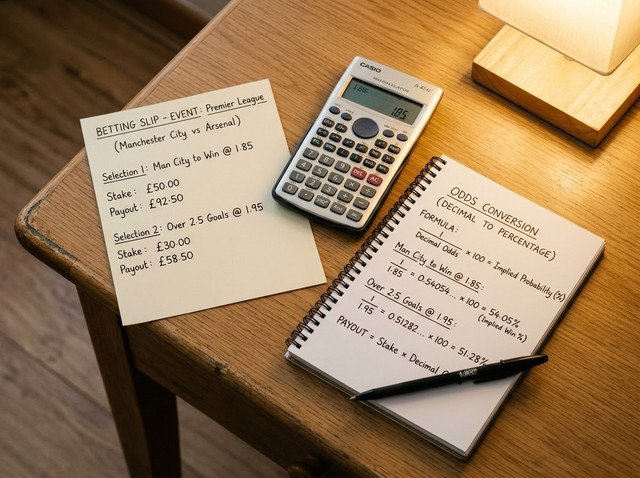
Formula: Implied Probability (%) = 1 / Decimal Odds × 100
Example: 6.00
- Implied Probability = 1 / 6.00 × 100 = 16.7%
- Same as 5/1 fractional — they are equivalent
Example: 5.50
- Implied Probability = 1 / 5.50 × 100 = 18.2%
- Same as 9/2 fractional
Example: 2.00
- Implied Probability = 1 / 2.00 × 100 = 50%
- Same as Evens (1/1)
American Odds to Implied Probability
Formula for positive odds (+): Implied Probability (%) = 100 / (Positive Odds + 100) × 100
Example: +500
- Implied Probability = 100 / (500 + 100) × 100 = 100 / 600 × 100 = 16.7%
- Same as 5/1 or 6.00
Formula for negative odds (-): Implied Probability (%) = |Negative Odds| / (|Negative Odds| + 100) × 100
Example: -110
- Implied Probability = 110 / (110 + 100) × 100 = 110 / 210 × 100 = 52.4%
- Interpretation: -110 implies the bookmaker thinks this outcome has a 52.4% chance
The Vig/Overround — Why 110% Book Doesn't Mean 100% Market
If you add up the implied probabilities of all outcomes in a bet, they should equal 100% — but they never do. They always add up to more than 100%. The extra percentage is the vig (vigorish) or overround — the bookmaker's built-in profit margin.
Worked Example: Two-Outcome Market (Tennis Match)
Imagine a tennis match between Player A and Player B:
- Player A odds: 1.90 (decimal) = 1 / 1.90 × 100 = 52.6% implied probability
- Player B odds: 1.90 (decimal) = 1 / 1.90 × 100 = 52.6% implied probability
- Total market: 52.6% + 52.6% = 105.2%
The market adds up to 105.2%, not 100%. The extra 5.2% is the vig — the bookmaker's edge. This means if you bet equal amounts on both players, you lose 5.2% of your total stake no matter who wins.
Worked Example: Three-Outcome Market (Football Match)
Imagine a football match with Home Win, Draw, Away Win:
- Home Win: 2.50 = 1 / 2.50 × 100 = 40.0%
- Draw: 3.40 = 1 / 3.40 × 100 = 29.4%
- Away Win: 3.00 = 1 / 3.00 × 100 = 33.3%
- Total market: 40.0% + 29.4% + 33.3% = 102.7%
The vig here is 2.7% — lower than the tennis example, meaning this is a better-value market for bettors. Lower vig = better value.
Typical Vig Percentages by Market
- Major football leagues (Premier League, Champions League): 2-5% vig
- Tennis (ATP, WTA): 4-6% vig
- NBA, NFL: 4-5% vig (typically -110 on both sides = 52.4% + 52.4% = 104.8% market)
- Smaller leagues or exotic markets: 8-15%+ vig (much worse value)
Key insight: The vig is quietly eating your bankroll. Even at 5% vig, you must win 52.4% of your bets just to break even on -110 odds. This is why most bettors lose long-term — the math is against them from the start.
Value Betting Explained (With Odds vs True Probability Example)
Value betting is when the odds offered imply a lower probability than your assessed true probability of the outcome happening. It is the only way to beat bookmakers long-term.
Worked Example
Imagine a football match where you have done deep analysis and believe:
- Your assessed probability: Team A has a 55% chance of winning
- Bookmaker odds: Team A at 2.20 (decimal)
- Implied probability from odds: 1 / 2.20 × 100 = 45.5%
Comparison:
- Your probability: 55%
- Bookmaker's implied probability: 45.5%
- Difference: 55% - 45.5% = 9.5% edge
This is a value bet. The bookmaker thinks Team A has a 45.5% chance; you believe they have a 55% chance. Over many similar bets, you will profit because you are getting better odds than the true probability justifies.
Value Formula
Formula: Value = (Your Probability × Decimal Odds) - 1
Example:
- Your Probability = 55% = 0.55
- Decimal Odds = 2.20
- Value = (0.55 × 2.20) - 1 = 1.21 - 1 = 0.21 = 21% value
Positive value (above 0) = good bet. Negative value (below 0) = bad bet.
Why Value Betting Is Hard
The challenge is accurately assessing true probability. Bookmakers have teams of analysts, huge datasets, and decades of experience. To find value, you must either:
- Know more than the market: Have information or analysis the bookmaker does not (e.g., team news, injuries, tactical insights)
- Find inefficiencies: Target smaller markets where bookmakers have less data (lower-division leagues, player props, exotic markets)
- Use quantitative models: Build statistical models that identify mispriced odds based on historical data
Without an edge, you are just guessing — and the vig ensures you lose long-term.
Quick Reference Table: Odds Conversion
| Fractional | Decimal | American | Implied Probability | Example Return on £10 |
|---|---|---|---|---|
| 5/1 | 6.00 | +500 | 16.7% | £60 total (£50 profit + £10 stake) |
| 9/2 | 5.50 | +450 | 18.2% | £55 total (£45 profit + £10 stake) |
| 4/1 | 5.00 | +400 | 20.0% | £50 total (£40 profit + £10 stake) |
| 3/1 | 4.00 | +300 | 25.0% | £40 total (£30 profit + £10 stake) |
| 2/1 | 3.00 | +200 | 33.3% | £30 total (£20 profit + £10 stake) |
| 6/4 | 2.50 | +150 | 40.0% | £25 total (£15 profit + £10 stake) |
| Evens (1/1) | 2.00 | +100 | 50.0% | £20 total (£10 profit + £10 stake) |
| 4/6 | 1.67 | -150 | 60.0% | £16.70 total (£6.70 profit + £10 stake) |
| 1/2 | 1.50 | -200 | 66.7% | £15 total (£5 profit + £10 stake) |
| 1/4 | 1.25 | -400 | 80.0% | £12.50 total (£2.50 profit + £10 stake) |
Final Word: Understand the Math Before You Bet
Betting odds are not random numbers — they are mathematical expressions of probability plus the bookmaker's vig. Understanding implied probability lets you compare odds across formats (fractional, decimal, American) and identify where the market offers value.
The vig ensures bookmakers profit long-term — even at 5% vig, you must win 52.4% of your bets just to break even. Value betting — finding odds that imply lower probability than your assessed true probability — is the only way to overcome this edge.
Before placing any bet, ask yourself: do I believe this outcome is more likely than the implied probability suggests? If yes, you may have found value. If no, you are betting blindly — and the math says you will lose.
Disclaimer: This article is for educational purposes only. Sports betting involves risk. Never bet money you cannot afford to lose. Past performance does not guarantee future results. All odds examples are illustrative and may not reflect current market prices.